
12.3.1How close am I to the curve?
Error Bound for Alternating Taylor Polynomials
ACCURACY AND APPROXIMATIONS
Sketch
and , its fourth-degree Taylor polynomial centered at . If
can be used to approximate and , do you think that is a better approximation of than is of ? Explain. If
is the sixth-degree Taylor polynomial centered at for , which will give a better approximation of : or ? Explain your reasoning. Summarize the ideas of parts (b) and (c). What two factors influence the accuracy of a polynomial’s approximation?
Taylor polynomials are useful for approximating the value of a function, but there will always be an error. Even small errors could lead to catastrophic results for scientists and engineers. So, before evaluating a Taylor polynomial, it is important to have a sense of the margin of error for a given value of
Your Challenge: Find a decimal value for Hint: The Taylor polynomial for |
Since the Taylor series,
, has infinitely many terms, will accurately calculate the value of . However, it is not practical (or humanly possible) to evaluate infinitely many terms! Approximating the value of using a Taylor polynomial, with a finite number of terms, will be much more efficient.
Make a prediction: What is the minimum number of terms that a Taylor polynomial centered atneeds to have in order to predict the value of within two decimal places accuracy? In order to answer this question, make a table of data. Let
represent the degree of the Taylor polynomial for centered at , and let represent the polynomial approximation. Examine your table. As
increases, what value does seem to be converging to? What do you predict the actual value of to be? To check the accuracy of your prediction, use your calculator to obtain a decimal value of
. In order to approximate within two decimal places accuracy, what degree Taylor polynomial centered at should you use for ?
BOUNDING THE ERROR for Alternating Taylors Series
In problem 12-88, you created a table of data to determine the lowest degree polynomial in which a Taylor polynomial centered at
In the case of
Explain why the Taylor series for
centered at can be considered an alternating series. Consider the sixth-degree polynomial such that
. Express each term of the alternating series
as a fraction, and look for a pattern among the consecutive terms. term
term value
ifRefer to the table you created in part (b) of problem 12-88. When using the third-degree Taylor polynomial,
, you approximated that . Use the table above to explain why that approximation must be less than of the actual value of . If you know the Taylor series that corresponds with an
th-degree Taylor polynomial, then the error when evaluating that polynomial at can be calculated by evaluating the next (non-zero) term of the Taylor series at . However, this only works if the terms of the corresponding Taylor series decrease and alternate. Explain why it is essential that the terms of the corresponding Taylor series decrease.
Explain why it is essential that the terms of the corresponding Taylor series alternate.
Determine the maximum error when using
, the fifth-degree Taylor polynomial centered at , to approximate . Justify your answer.
Let
Use
, the third-degree Taylor polynomial for centered at , to approximate the value of . What is the maximum error of your approximation? Justify your answer.
Use your calculator to compute the actual error. Confirm that it is less than the maximum error you computed in part (b).

Error Bound (for alternating Taylor Polynomials)
Suppose
Then the error of
error of | the next non-zero term of |

Write the equation of the fourth-degree Taylor polynomial centered at
A projectile is launched from the ground at a
Write the velocity vector as a function of
. Calculate the magnitude of the velocity vector at
and at the moment when the projectile hits the ground. Make a conjecture about the speed with which projectiles returns to earth.
Rewrite the polar equation
No calculator! The region under the curve
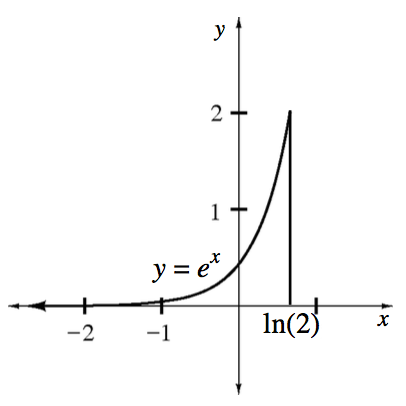

Consider the infinite series below. For each series, decide if it converges conditionally, converges absolutely, or diverges and justify your conclusion. State the tests you used. Homework Help ✎
Multiple Choice: A point moves in the plane according to the set of parametric equations
undefined
Multiple Choice: What is the solution to the differential equation
Multiple Choice: Acme office furniture is selling computer chairs for
There is no maximum amount.
.png)


